Clam Rock Festival 2026 @ Clam Castle / Burg Clam
Clam Castle / Burg Clam, Meierhofwiese, 4352 Klam Kort
fös. 03.07.2026 13:00
Clam Rock Festival 2026 at Clam Castle / Burg Clam at 2026-07-03T13:00:00+0200
Flytjendur
-
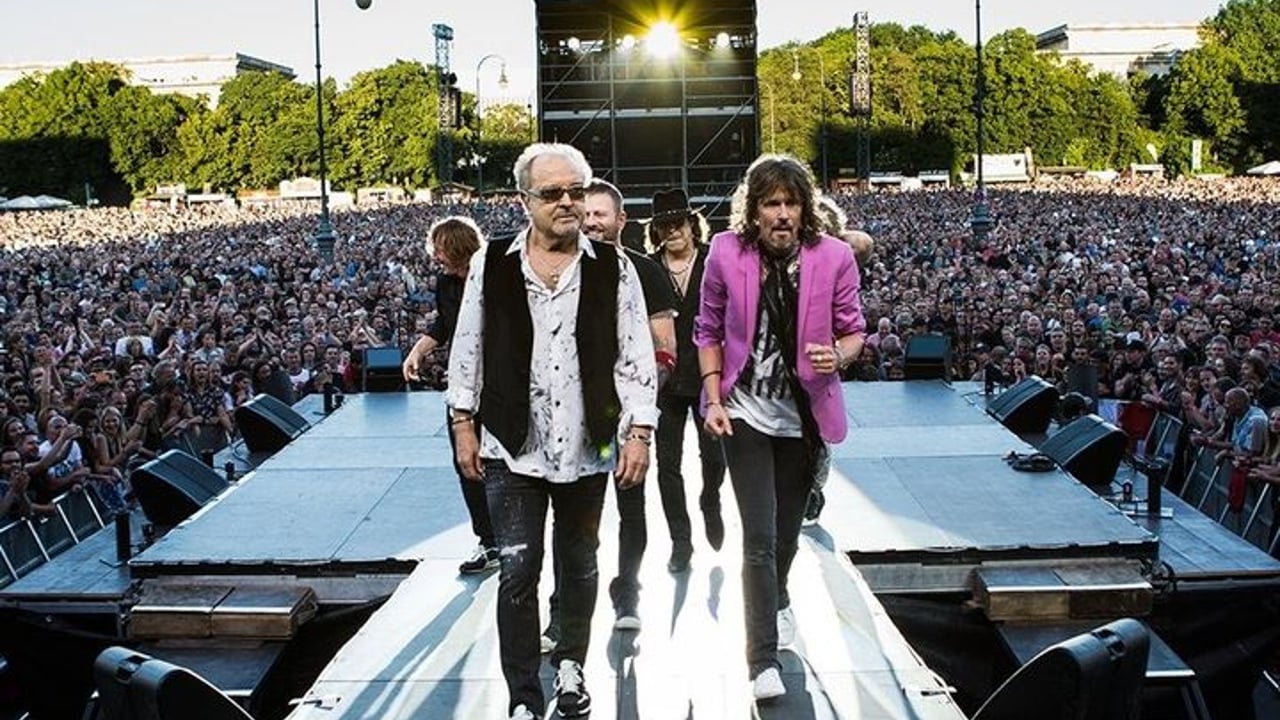
Foreigner
With ten multi-platinum albums and sixteen Top 30 hits, Foreigner is universally hailed as one of the most popular rock acts in the world with a formidable musical arsenal that continues to propel sold-out tours and album sales, now exceeding 75 million. Responsible for some of rock and roll’s most enduring anthems including “Juke Box Hero,” “Feels Like The First Time,” “Urgent,” “Head Games,” “Hot Blooded,” “Cold As Ice,” “Dirty White Boy,” “Waiting For A Girl Like You,” and the worldwide #1 hit, “I Want To Know What Love Is,” Foreigner continues to rock the charts almost 40 years into the game.
Founded in 1976, Foreigner’s debut album produced the hits “Feels Like The First Time,” “Cold As Ice” and “Long, Long Way From Home.” The album Double Vision followed, as did a string of hits like “Urgent,” “Juke Box Hero” and “Waiting For A Girl Like You.” Those songs helped give Foreigner’s next album, 4, its impressive run at #1 on the Billboard chart. At the zenith of 80’s sound, Foreigner’s fifth album, Agent Provocateur, gave the world the incredible #1 global hit,” I Want To Know What Love Is.” This musical milestone followed the record-breaking song “Waiting For A Girl Like You.”
At Foreigner’s core is the founder and Songwriters Hall of Fame member Mick Jones, the visionary maestro whose stylistic songwriting, indelible guitar hooks and multi-layered talents continue to escalate Foreigner’s influence and guide the band to new horizons. He reformed the band after a 2002 hiatus and selected lead singer Kelly Hansen to help write an inspired new chapter in the history of Foreigner. One of rock’s greatest showmen, Hansen is known for his innate ability to connect with the crowds. As a front man and lead vocalist, Hansen is among the most respected, consummate professionals in rock and roll. With a 35-year career that spans almost every area of music, from the role of lead vocalist to producing and engineering, Kelly has the unique ability to advance and excel when faced with new challenges.
Mick also brought in bassist Jeff Pilson, multi-instrumentalist Tom Gimbel, guitarist Bruce Watson, Michael Bluestein on keyboards, and Chris Frazier on drums. An unprecedented new level of energy lead the group to a re-emergence of astounding music that speaks to long time Foreigner fans and younger generations. With renewed vitality and direction, Foreigner hit the Billboard charts again with the 2005 release of their live greatest hits album, Extended Versions. Can’t Slow Down followed in 2009 and entered the Billboard chart in the Top 30, driven by two Top 20 radio singles, “In Pieces” and “When It Comes To Love.” To follow was the release of the band’s 3-disc set, Feels Like The First Time, which included an acoustic CD with an intimate and unique re-interpretation of many Foreigner classics, studio re-records by the new lineup and a live performance DVD showcasing the group’s exceptional live energy.
Foreigner experienced another surge in popularity when several of their hits were featured on the Rock of Ages soundtrack, including “I Want To Know What Love Is,” “Juke Box Hero” and “Waiting For A Girl Like You” – more songs than any other one band on the soundtrack. Hollywood quickly took note, and several more tracks were featured in hit films “Anchorman 2,” “Magic Mike” and “Pitch Perfect,” sending Foreigner downloads up 400%. The video game industry was soon to follow with the blockbuster release, “Grand Theft Auto V”. Downloads continued to soar after their worldwide #1 hit “I Want To Know What Love Is” was featured as the 2015 season finale end title of “Orange Is The New Black.” Foreigner hits have also recently been included in such primetime TV shows as “The Late Show with Stephen Colbert" and “The Tonight Show with Jimmy Fallon,” among others. Hot Blooded is on the trailer for the Angry Birds movie and has been streamed more than 6 million times. The high visibility of Foreigner’s songs continues to introduce the band’s music to a whole future generation of fans, exemplified by Jack Black’s version of “Juke Box Hero” in Kung Fu Panda 3.
In June 2013, Mick Jones was inducted to the Songwriters Hall Of Fame. A multi-talented and multi-dimensional “musician’s musician,” Jones has also written songs such as “Bad Love” with Eric Clapton and “Dreamer” with Ozzy Osbourne, and produced records for others including Billy Joel’s Storm Front and Van Halen’s 5150. A Grammy and Golden Globe-nominated songwriter, Jones is the winner of the prestigious British Ivor Novello Songwriter Award for “The Flame Still Burns”, the soundtrack music for the film Still Crazy.
In May 2014, Atlantic Records Chairman Craig Kallman presented Mick Jones with RIAA gold and platinum digital awards for six Foreigner songs. These awards signify 500,000 and 1,000,000 downloads of Foreigner hits. That is more individual awards than any other heritage rock band, and an illustration of Foreigner’s resonance in the digital era.
The year continued with Foreigner’s headline run in The Soundtrack of Summer US amphitheater tour. The hits compilation album of the same name was released to coincide with the tour and immediately hit the Billboard Top 200 chart, peaking at #64. For most weeks during the tour, Juke Box Heroes joined The Soundtrack Of Summer in the Billboard Top 200 making Foreigner the only Classic Rock band to have such a remarkable presence in today’s chart.
Recent albums like Juke Box Heroes, a new compilation of digitally recorded Foreigner hits, and The Best of Foreigner 4 & More, recorded live from The Borgata, continue to chart, with Billboard recently releasing their “Greatest of All Time” lists featuring Foreigner hits in every category. Catalog sales often eclipse those of AC/DC, Aerosmith, The Rolling Stones, Queen, Van Halen and most of their Classic Rock peers (Source: Nielsen SoundScan Top 200, September 15, 2013).
Foreigner made headlines again in the summer of 2015 by joining mega act Kid Rock on his “Cheap Date: First Kiss Tour,” rocking amphitheatres and stadiums across the United States. One of the only heritage acts to commence a tour of this magnitude, Foreigner gained in legions of new fans as part of this legendary partnership.
The year 2015 also brought Foreigner’s partnership with Ford’s Drive 4 UR School campaign, where Ford joined Foreigner’s successful high school choir promotion in several markets, donating funds and allowing winning choirs the chance to join Foreigner onstage.
In February 2016, Foreigner released their first-ever live acoustic album In Concert. Unplugged. The band’s royalties will be donated to JDRF (Juvenile Diabetes Research Foundation) and the album is available exclusively via Amazon. Foreigner recorded this unique acoustic album at a once-in-a-lifetime private concert hosted by Edsel B. Ford II on August 24, 2015 at the Ford Motor Company Conference & Event Center in Detroit, MI.
Foreigner kicked off 2016 with a much hailed unplugged appearance on The Today Show on February 11th followed by a short run of New York area sold out acoustic shows culminating with an epic concert at The Lincoln Center as part of the acclaimed American Songbook Series.
Foreigner is one of the most viewed YouTube artists with anywhere between 700,000 and 900,000 weekly viewings of their songs (Source: Next Big Sound).
-
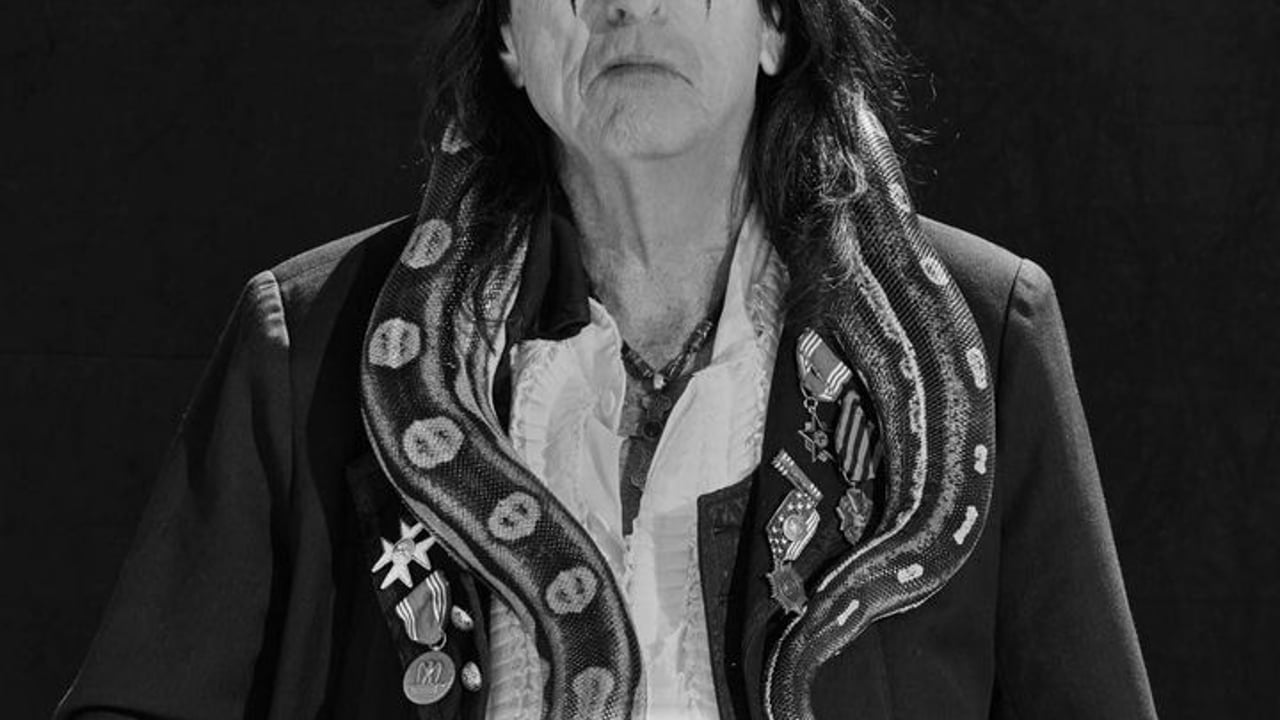 Alice Cooper
In 1975, Alice Cooper joined forces with longtime collaborator and producer Bob Ezrin to record his first solo album Welcome to My Nightmare, a theatrical concept album about the nightmares of a young boy named Steven. Now, he’s followed Steven into adulthood and presents Welcome 2 My Nightmare, a new but familiar concept album about the fear, anxiety and disgust that haunt Alice Cooper’s dreams in an era of Facebook, Lady Gaga, Sketchers and Angry Birds.
“Alice hates technology, disco is still a nightmare for him and working in a cubicle from nine-to-five would give him cold sweats,” Cooper says. “At the same time, this is a nightmare so all these normal life things are thrown into this crazy world that’s only logical when you’re in the nightmare. You could have an elephant in your garage, and you’re on the lawn in a pink tutu cooking hot dogs. And at the time it’s fine. But when you wake up you go, ‘How insane is that? Where did that come from?’ So we realized that having Alice in a modern-world nightmare is a great place to come from theatrically because we can go anywhere we want and make it as insane as possible.”
A wild, surreal odyssey, Welcome 2 My Nightmare provided Cooper and Ezrin the opportunity to work with numerous musicians and experiment with various musical styles. The three surviving members of the original band, guitarist Michael Bruce, bassist Dennis Dunaway and drummer Neal Smith, co-wrote three songs and they all played on “When Hell Comes Home,” a gritty ‘70s-style rock track about the nightmare of domestic abuse. “I wanted the song to feel like it was off of Love it to Death or Killer, Cooper says. “But we never had to talk about playing the song ‘70s-style, they just did it. It was great and there was nothing we could do to make it any more ‘70s ‘cause that’s just the way these guys play.”
The collaborations with his fellow original band members stemmed from their 2010 induction into the Rock and Roll Hall of Fame, for which they reunited to play four songs. “I was always looking for a logical reason to work with them again,” Cooper says. “When we broke up there was no bad blood. Most bands break up and they start suing each other. We never broke up on that level. We broke up on a very friendly level. ‘You go do what you’re gonna do, I’m gonna do what I’m gonna do. Let’s see what happens.’ When we got in the Hall of Fame I called them up and I said, ‘We have to do four songs. Let’s get together and rehearse.’ And they sounded great. They played great. We did a few projects after that. We played a couple times together. And I said, ‘Let’s keep it going. Let’s get these guys on the album.’ And Bob said, ‘That’s a great idea. Let’s write with these guys.’ It just worked.”
The first single from Welcome 2 My Nightmare, “I’ll Bite Your Face Off,” is about a gorgeous but deadly female who takes Alice by the hand and guides him through the various scenes of his nightmare. The song was co-written by Neal Smith and features a swaggering ‘60s British rock rhythm, brash, bluesy guitars and sneering, seductive vocals. “We tried to make this sound as much like early Rolling Stones as possible and we really did capture that,” Cooper says. “We’ve been doing it onstage and the audience sings along without knowing the song.”
On “Disco Bloodbath Boogie Fever,” Cooper combines a tongue-in-cheek disco beat and rhythm with near-rap vocals and lyrics about taking a machine gun to zombie disco dancers who refuse to die. Then there’s the zany surf rock of “Ghoul’s Gone Wild,” the derelict down-on-his-luck slur of “The Last Man on Earth,” and the Beatles meet Gary Glitter show tune “The Congregation,” which stars Rob Zombie as a narrator describing such modern-day nightmares as telemarketers, lawyers, pimps, mariachi bands and mimes.
One of the highlights for Cooper is the throbbing, modern rocker “What Baby Wants,” which stars Ke$ha as the devil. “Some people thought I was crazy to have Ke$ha on the record, but I never saw her as one of these Britney Spears diva girls. I saw her more as a rock singer. So I said, ‘Let’s present you not as a diva, but as a rock singer on this.’ We wrote the song together and in the end the darker lyrics were hers.”
Like The original Welcome To My Nightmare, which was highlighted by “Only Women Bleed,” Welcome 2 My Nightmare also features a lovelorn ballad, “Something to Remember Me By,” which was written with Dick Wagner back when they released “I Never Cry” in 1976. “We never used it on an album before because I never felt I was good enough to sing that song,” Cooper reflects. “It was never in my key, I could never get it right. Finally, we got it where my voice is in the right place so we included it and it may be the prettiest ballad we ever wrote. Steve Hunter played guitar on it and we really got a nice Beatles-y sound out of it. So when you’re listening to it you hear this really pretty romantic song and then you realize that in the Nightmare Alice is singing to a pile of bones that used to be a girl.”
Fans of the first Welcome To My Nightmare will recognize melodic references to the original woven throughout the new record. For example, in the cinematic minor-key song “The Nightmare Returns,” Ezrin plays the theme from “Steven” when Cooper sings, “I think we’ve heard that song before.”
“I really like the idea of having some of the musical identity of the first album showing up in the second album,” Cooper says. “It really connects the two and if you’re a real Alice fan and you hear those themes it makes you feel comfortable.”
Welcome To My Nightmare, which came out in 1975, was a landmark album for Cooper. It was his first solo release, following a historic string of anthems written and recorded by the original band between 1971 and 1974, including “School’s Out,” “No More Mr. Nice Guy,” “Elected,” and “I’m Eighteen.” A multimedia smash long before the dawn of music television, Welcome To My Nightmare proved that Cooper could remain popular musically and could take theatricality to an entirely new level of dream by exposing audiences to the crippling fears of a seven-year-old child with an active imagination.
Welcome To My Nightmare spawned two major singles, the ominous, anthemic title track and the beautiful, melancholy acoustic ballad “Only Women Bleed,” and featured narration by horror movie icon Vincent Price. In addition to touring the live “Welcome To My Nightmare” show, Cooper created the prime time special The Nightmare, which was essentially the first long form music video. The program debuted in April 1975. In September he shot the concert film “Welcome To My Nightmare” at London’s Wembley Arena.
“A seven-year-old kid is pretty sure there’s something living in the closet and thinks that something is waiting for him under his bed,” Cooper says. “His toys are probably coming to life and trying to kill him. And I thought, ‘Well, that’s a good general approach for the album because we’ve all been kids and we’ve all had those nightmares.’”
From his first solo album, 1975's Welcome to My Nightmare through releases such as 1994's The Last Temptation and 2000's Brutal Planet, concept albums have been a specialty of Alice's, and this time he spins the story of a serial killer who imagines himself as the most predatory of all insects, trapping his prey, killing them, then enveloping his eight victims in silk, taking a leg from each of them. A web of intrigue, wrapped around some serious hard rock.
Co-produced by Alice with the team of Danny Saber [Black Grape, Rolling Stones, Ozzy Osbourne, David Bowie] and Greg Hampton [Bootsy Collins, Buckethead], songs like the opening "I Know Where You Live" and "Vengeance Is Mine," featuring a snaking metal guitar solo from Slash himself, evoke such classic Alice anthems as "Is it My Body," and "Under My Wheels" along with landmark albums like Love It To Death, Killer and School's Out. There's also a patented rock ballad in the tradition of "Only Women Bleed" and "I Never Cry" with "Killed by Love." Along Came a Spider features Cooper's touring band of drummer Eric Singer, bassist Chuck Garric and guitarists Keri Kelli and Jason Hook. Songwriting was handled by Alice with Saber, Hampton, Garric, Kelli and a few friends including former band member Damon Johnson and Warrant's Jani Lane.
Along Came a Spider has elements of serial killers such as Hannibal Lecter, Son of Sam, Ted Bundy, Jack the Ripper, Sweeney Todd and Psycho's Norman Bates with Alice himself taking the central part, acting out the murderer's diary -- challenging reality by Alice Cooper inhabiting the identity of a serial killer who imagines himself a spider. As he has in the past, Alice chronicles a classic battle between good and evil, with inevitable results.
"Evil should get punished," says Alice. "It should never win. And that, to me, is what's most satisfying. I may love Darth Vader when I watch Star Wars, but I feel relief when he finally gets what's coming to him."
...Read Alice's full biography @ AliceCooper.com
-
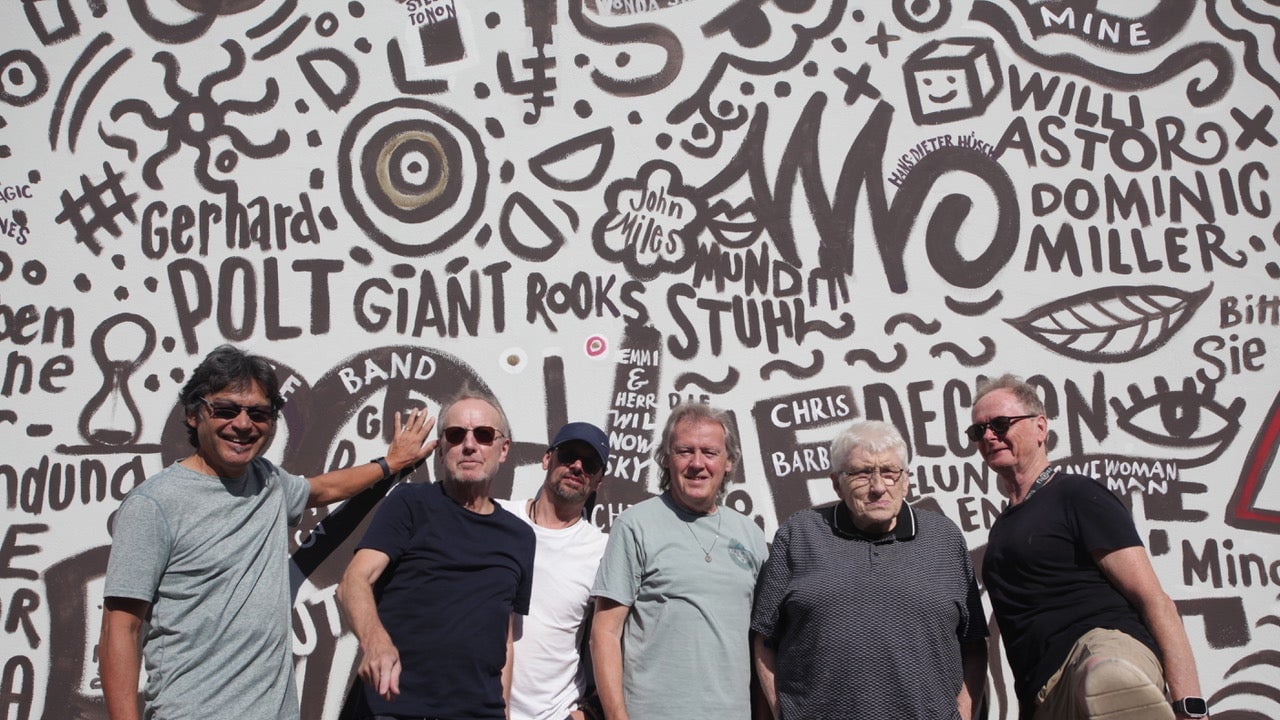
Manfred Mann's Earth Band
1970s and on - Manfred Mann's Earth Band Manfred Mann went on to write advertising jingles after the first group's demise, but also continued to work in the group format. Initially he formed Manfred Mann Chapter Three, an experimental group who evolved into Manfred Mann's Earth Band. The Earth Band was, from a pop perspective, almost deliberately contrary, but combined the stylistic approach of progressive rock with Mann's keen ear for melody. Mann's interest in English 20th century classical music saw him re-create Gustav Holst's Planets Suite, garnering an unlikely UK hit with a version of the "Jupiter" movement that had lyrics added and entitled "Joybringer". 1973's The Good Earth album tapped into ecological concerns, a recurring theme in Mann's music in later years, and had a free gift of a piece of land in Wales with each album sold. The membership of the Earth Band was relatively informal; Mick Rogers originally performed lead guitar and lead vocal duties before being replaced by Chris Thompson on vocals and Dave Flett on guitar. Drumming duties were fulfilled by Chris Slade, who was later to be a member of AC/DC and Asia in a long and varied career which perhaps can be summed up by his being released by AC/DC despite being, according to the rest of the band, the best musician in the band. Similarly, the technically skilled bass player Colin Pattenden, after leaving the Earth Band, became a sound consultant, running his own company designing and installing sound systems. There was much about the Earth Band that was potentially successful, but the contrariness of the band's approach and Mann's perfectionism meant that albums frequently came out with different track listings in different territories, or in alternative versions. The breakthrough for the band in the US came when they had a No. 1 pop charts hit in early 1977 with Bruce Springsteen's "Blinded by the Light". While the Springsteen original from 1973's Greetings From Asbury Park, N.J. album has a folky, acoustic sound, the Manfred Mann's Earth Band version is driving rock, combining Mann's Moog synthesizer and organ work with Flett's guitar. Manfred can be heard singing at the end of "Blinded By The Light", in the round, with Thompson - it was this feature of the song that initially attracted him. The band took advantage of the publicity and re-released another Springsteen song, "Spirit in the Night", which had been recorded the previous year on Nightingales and Bombers, originally with Rogers on vocals although for some territories it was re-recorded with a vocal from Thompson. Nightingales and Bombers, The Roaring Silence, and Watch are considered the highlight of the Earth Band's achievement. Watch produced another hit single in "Davy's On The Road Again", and the albums were innovative and original despite the dependence on covers of other artists' songs. Nightingales and Bombers took its title from a World War II naturalist's recording of a nightingale singing in a garden as warplanes flew overhead; the recording appears in a track on the album. Roaring Silence featured a guest appearance by jazz saxophonist Barbara Thompson, and Watch included two stand-out recordings from the bands live performances of "Davy's On The Road Again" and "Mighty Quinn". Flett left before 1979's Angel Station to be replaced by Steve Waller, sharing the vocal duties with Thompson who was also intent on pursuing a solo career. 1980's Chance showed a move towards a more electronic approach, and produced several cuts that were hits in the UK and/or saw significant airplay in both the US and UK. The songs "Lies (All Through The 80's)", "Stranded", and "For You" (another Springsteen song) still receive significant airplay over 25 years since their release. Mann became very active in the international anti-apartheid movement, and was banned from entering South Africa, the country in which he had been born. Instead members of the band made journeys to South Africa to record African musicians for the album Somewhere in Afrika, pre-figuring Paul Simon's Graceland. The album included a cover of The Police's "Demolition Man" and a well-received version of Bob Marley's "Redemption Song", which remains in the band's set today. American versions of the album also included Ian Thomas's "The Runner", whose music video had images of the Munich and Montreal Olympic Games, and which enjoyed much airtime in the lead-up to the Los Angeles Olympics. Manfred Mann's Earth Band has continued recording to the present day, covering tracks by artists as varied as Paul Weller, Robert Cray, Del Amitri, and The Lovin' Spoonful. Mann has also released a solo project, Plains Music, based on Native American music, and his latest album, 2006, includes collaborations with the German rapper Thomas D and tracks featuring the music of, amongst others, the Super Furry Animals. The Earth Band remain active in live performances in Europe, with a line up that includes both Manfred Mann and Mick Rogers. Most of the band's albums have been re-released in recent years and a 4-CD set featuring many previously unissued versions of tracks was released in August 2005. This includes material from the unreleased (and thought to be lost) Manfred Mann ChapterIII Volume 3 album and the first Earth Band album, Stepping Sideways. The fourth CD in the package includes both unreleased studio material and live performances.