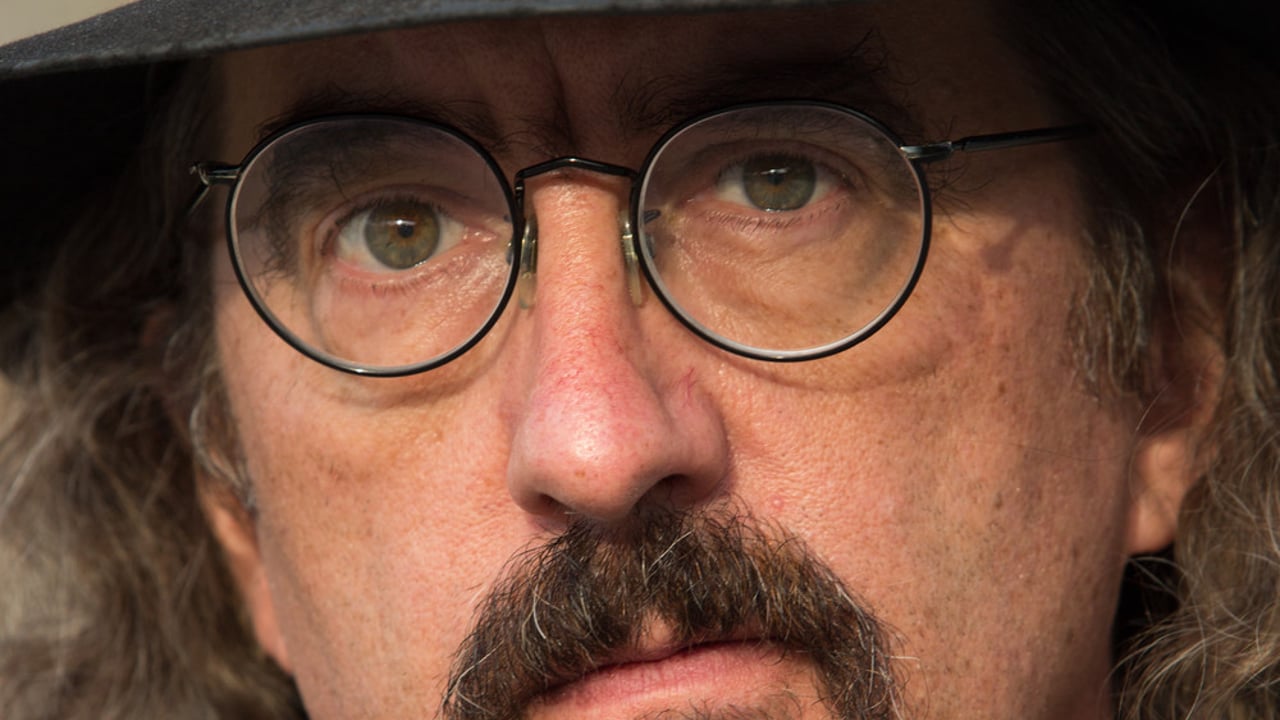
James McMurtry
Brudenell Social Club, 33 Queens Road, LS6 1NY Leeds Kort
mið. 07.10.2026 19:30
Brudenell Presents...
James McMurtry The Black Dog & the Wandering Boy
A Lone Star sheriff hunts quail on horseback and keeps a secret second family. A mechanic lies among the spare parts on the floor of his garage and wonders if he can afford to keep his girlfriend. A troubled man sees hallucinations of a black dog and a wandering boy and hums "Weird Al" songs in his head. These are some of the strange and richly drawn characters who inhabit James McMurtry's eleventh album, The Black Dog & the Wandering Boy. A supremely insightful and inventive storyteller, he teases vivid worlds out of small details,setting them to arrangements that have the elements of Americana-rolling guitars, barroom harmonies, traces of banjo and harmonica-but sound too sly and smart for such a general category. Funny and sad often in the same breath, the album adds a new chapter to a long career that has enjoyed a resurgence as young songwriters like Sarah Jarosz and Jason Isbell cite him as a formative influence.
As varied as they are, these new story-songs find inspiration in scraps from his family's past: a stray sketch, an old poem by a family friend, the hallucinations experienced by his father, the writer Larry McMurtry. "It's something I do all the time," he says, "but usually I draw from my own scraps." As any good writer will do, McMurtry collects little ideas and hangs on to them for years, sometimes even decades. "South Texas Lawman" grew out of a line from a poem by a friend of the McMurtry clan, T.D. Hobart. Driven by gravelly guitars and a loose rhythm section, it's a careful study of a man whose feelings of obsolescence motivate him to take drastic action in the final verse. "Dwight'd stay at our house way back in the '70s, when we lived in Virginia. During one visit he wrote this poem about his father's attitude toward South Texas. He wrote it down on cardboard, and I came across it recently. There was a line about hunting quail on horseback, and that was the seed of the song. I've lost the poem since then."
The rumbling title track, a kind of squirrelly blues, features two mysterious figures who appear only to those slipping from reality, yet it's never grim nor especially despairing. Instead, McMurtry namechecks a "Weird Al" deep cut and depicts a tortured soul who doesn't have to work a nine-to-five. He finds a defiant humor in the situation at odds with the gravity of the source material. "The title of the album and that song comes from my stepmother, Faye. After my dad passed, she asked me if he ever talked to me about his hallucinations. He'd gone into dementia for a while before he died, but hadn't mentioned to me anything about seeing things. She told me his favorite hallucinations were the black dog and the wandering boy. I took them and applied them to a fictional character."
Soon McMurtry had enough of these songs for a new record. "It happened like all my records happened. It'd been too long since I'd had a record that the press could write about and get people to come out to my shows. It was time." What was different this time was the presence of his old friend Don Dixon, who produced McMurtry's third album, Where You'd Hide the Body?, back in 1995. "A couple of years ago I quit producing myself. I felt like I was repeating myself methodologically and stylistically. I needed to go back to producer school, so I brought in CC Adcock for Complicated Game, and then Ross Hogarth did The Horses & the Hounds. It seemed natural to revisit Mr. Dixon's homeroom. I wanted to learn some of what he's learned over the last thirty years." During sessions at Wire Recording in Austin, McMurtry observed firsthand Dixon's grasp of digital recording technology as well as his instinctual approach to tracking. "What Don's really good at is being able to sense when it's happening. He can hear when it's going down. If I'm producing myself and I don't have him, I have to do three takes and then go in and listen to them. Listening to those three takes can take about 15 minutes. So Dixon's ability to know when it's happening is crucial, because it can cut 15 minutes out of the day. That can really save a session, because you only have so many hours in the day and only so much energy.
Working with McMurtry's trusted backing band-Cornbread on bass, Tim Holt on guitar, Daren Hess on drums, BettySoo on backing vocals-they worked to create something that sounds spontaneous, as though he's writing the songs as you hear them. They were open to odd experiments, weird whims, and happy accidents, such as the cover of Jon Dee Graham's "Laredo" that opens the album. It's an opioid blues: testimony from a part-time junkie losing a weekend to dope. "We were playing a benefit for Jon Dee at the Hole in the Wall there in Austin, and we thought it'd be good if we played one of his songs. We rehearsed the song in the studio, and it sounded good. The drums were ready. We'd already got the sounds up. Might as well record it."
"Laredo" is one of a pair of covers that bookend The Black Dog & the Wandering Boy, the other being Kris Kristofferson's "Broken Freedom Song." "I did that one a few weeks after our initial sessions. It was just me and BettySoo, then we added drums and bass later on. Kris had just passed not too long before we recorded it. I guess that's why I was thinking about him." Like Hobart's poem, it's a bit of inspiration excavated from deep within his own life. "Kris was one of my major influences as a child. He was the first person that I recognized as a songwriter. I hadn't really thought about where songs came from, but I started listening to Kristofferson as a songwriter and thinking, How do you do this? He was actually the second concert I saw. I was nine. He and the band were having such a good time, and that really solidified for me that this was what I wanted to do with my life."
Once the album was mixed, mastered, and sequenced, McMurtry recalled a rough pencil sketch he had found a few years earlier in his father's effects. It seemed like it might make a good cover. "I knew it was of me, but I didn't realize who drew it. I asked my mom and my stepdad, and finally I asked my stepmom, Faye, who said it looked like Ken Kesey's work back in the '60s. She was married to Ken for forty years." The Merry Prankster's-Kesey's roving band of hippie activists and creators-stopped by often to visit Larry McMurtry and his family. "I don't remember their first visit, the one documented in Tom Wolfe's Electric Kool-Aid Acid Test. I was too young, but I do remember a couple of Ken's visits. I guess he drew it on one of those later stops. I remembered it and thought it would be the perfect art, but I had to go back through the storage locker. It's a miracle that I found it again."
It's a fitting image for an album that scavenges personal history for inspiration. Even the songwriter himself doesn't always know what will happen or where the songs will take him. "You follow the words where they lead. If you can get a character, maybe you can get a story. If you can set it to a verse-chorus structure, maybe you can get a song. A song can come from anywhere, but the main inspiration is fear. Specifically, fear of irrelevance. If you don't have songs, you don't have a record. If you don't have a record, you don't have a tour. You gotta keep putting out work."
Flytjendur
-
James McMurtryGrowing up, Jonathon Linaberry was obsessed with the radio.
“Music was my whole world,” he recalls, “and the radio was pivotal in that. There was
something so romantic about it. You never knew what you’d hear, what you’d discover and fall
in love with. I wanted to find a way to recapture that.”
Radio Waves, Linaberry’s sixth studio album as The Bones Of J.R. Jones, is indeed steeped in
the past, but there’s more than just nostalgia at play here. Recorded in Toronto with producer
Robbie Lackritz (Feist, Bahamas), the collection is moody and hypnotic, drawing on the sonic
landscape of Linaberry’s youth as it reckons with all the doubt and uncertainty of adulthood.
The arrangements are utterly entrancing, built on the tension between acoustic instruments
and retro synthesizers, and Linaberry’s performances are raw and visceral, at times aching in
their unflinching vulnerability. Put it all together and you’ve got a poignant exploration of
memory and longing delivered by a relentless searcher, a revelatory work of personal
reflection rooted in the endless beauty, pain, and chaos that comes with finding your place in
this world.
“I’ve never really resonated with the idea of ‘the good old days,’” Linaberry reflects. “Your
understanding of the past and your relationship with it change as you get older, and I’ve
always been more interested in the evolution of those feelings than in looking at them with
any kind of rose-colored glasses.”
Born and raised in central New York, Linaberry got his start playing in hardcore and punk
bands before becoming enamored with the field recordings of Alan Lomax, who documented
rural American blues, folk, and gospel musicians throughout the 1930s and ’40s. Inspired by
the unvarnished honesty of those vintage performances, Linaberry launched The Bones of J.R.
Jones in 2012 and, operating as a fully independent artist, began releasing a series of
critically acclaimed albums and EPs that would land his songs in a slew of films and television
shows (including True Detective, Suits, Daredevil, Longmire, and Graceland) and lead to
countless tours across the US and Europe (including stops everywhere from Telluride Blues to
Hardly Strictly Bluegrass). Along the way, Linaberry also shared bills with the likes of The
Wallflowers, G. Love, and The Devil Makes Three, soundtracked an Amazon commercial
helmed by Oscar-winning director Taika Waititi, and earned praise from Billboard, American
Songwriter, Under the Radar, and more.
“After a dozen years of touring and recording, I found myself getting burnt out by the
constant barrage of new music that’s out there,” Linaberry reflects. “In some ways, it’s great
to have that kind of access, but it can also be numbing, and I found myself missing what it
felt like to have an album change your life, to listen to your cassette of Born In The USA so
many times you have to wind the tape back up with a pencil.”
Linaberry set out to tap back into that magic on Radio Waves, writing songs steeped in the
sounds and stories of his own coming of age. He tuned out the modern world in favor of stark,
lo-fi demos built around fingerpicked guitars and old school electronics, and when it came
time to record the album, he leaned into working with an outside producer for the first time,
traveling to Canada for two ten-day sessions at Lackritz’s studio.
“A lot of these songs started on a drum machine, which was very intentional,” Linaberry
explains. “I wanted to focus on simplicity, on stripping tracks back to their most essential
elements so that the melody and the vocals could shine.”
The result is an almost primal sound, familiar yet uneasy, like a memory hanging perpetually
just out of reach.
“These songs live in the night—the endless kind, where you get in your car just to drive and
listen to music, to feel like you’re going somewhere even if you’re not,” Linaberry says. “It’s
the sound of a kitchen heavy with the leftover heat of an August day and a table crowded
with drinks, of arguments and first loves and first heartbreaks, of not living up to your
potential, of breaking promises, of being human.”
Take a listen to album opener “Car Crash” and you’ll understand exactly what he means.
Tender and hazy, the track offers up a bittersweet embrace of life’s imperfections, finding
meaning and connection in our shared flaws and shortcomings. “I want your whole heart,”
Linaberry professes, “even the broken parts.” Like much of the record, it’s insistent yet
understated, as much a celebration as it is a confession. The sensuous “Savages” revels in the
reckless abandon of young adulthood, while the spare “Heart Attack” stares disappointment
directly in the face, and the piercing “Shameless” works its way through a lifetime of what
ifs.
“Our lives are an endless series of revolving doors,” Linaberry reflects. “Even the smallest
decisions can change our entire trajectory. What kind of arrogant fool doesn’t look back and
wonder?”
That sense of lostness, of uncertainty as to who we are and where we belong turns up
throughout the record. The blistering “Drive” devours itself from the inside out in the tedious
solitude of the road; “The Devil” grapples with identity, intimacy, and dependence; and the
breezy “Catching You” wonders what we were ever trying to prove with all the debaucherous
nights and bad decisions of youth.
“I think so many of us live in the past because it’s easier to face than the future,” Linaberry
explains. “But I’m not interested in going back. I’m interested in understanding the feelings
and experiences that made us who we are: the passion and the hunger, the faults and the
failures, the hopes and the fears.
Truth be told, those feelings never really go away. They’re all still out there, floating in the
ether, drifting through eternity on an endless sea of radio waves. All you have to do is tune in.